Tuesday, November 19, 2013

James Monroe

During the presidency of James Monroe many events had occurred throughout Europe. These events eventually became a concern for the United States. Monroe had many issues to address, all at the same time. The Quintuple Alliance had formed at the Congress of Vienna; they introduced the Principle of Intervention. It gave the great nations the right to to send in troops into a country to stop revolutions and restore monarchs. 

This gave the alliance to send armies to the new world and recapture independent Spanish settlements. Monroe address this issue by stating  "With the existing colonies or dependencies of any European power we have not interfered and shall not interfere. But with the Governments who have declared their independence and maintain it, and whose independence we have… acknowledged". Meaning that the United States will not get involved will European colonies that have not become independent, but those that have already become independent will remain independent. He says that if the European nation try to recapture an independent settlement, the United States will get involved and defend the Latin American colony. 

Another issue that Monroe had to address was the Russian settlements in North America. The Russian were claiming and settling on land in the northwest. If they successfully controlled the area America would lose its ability to trade with Asia through the Pacific Ocean. Monroe addressed this by stating "the minister of the United States at St. Petersburg to arrange by amicable negotiation the respective rights and interests of the two nations on the northwest coast of this continent.” Monroe set up negotiations with Russians to discuss the issue of the northwest territory in North America. He was able to avoid a war with Russia over land in this region and was able to keep a passage to the Pacific Ocean. 

The last issue Monroe had to address was a treaty with England. The English offered to help Monroe with the Russians in the northwest, if they worked together to keep the Alliance from regaining Spanish colonies. But Monroe was able to deal with both issues by himself and so he stated, "not to interfere in the internal concerns of any of its powers; to consider the government de facto as the legitimate government for us; to cultivate friendly relations with it, and to preserve those relations by a frank, firm, and manly policy." Meaning that they will not make a written alliance with England, but they will keep friendly relations with them as well as with all the other European nations. Monroe addressed all three of these issues in the "Monroe Doctrine", these issues originated from the conservative ideologies of the Quintuple Alliance.
 
The overall reaction to the Monroe doctrine was positive. The Russian were able to negotiate with the United States and avoided a war. The Latin American colonies that fought for their independence were able to keep it and have the support of the United States. The English didn't make the alliance with the United States, as they wanted to. But the United States kept a friendly relationship with them, and were able to keep the Spanish from regaining all their colonies which worked in England's favor. Some people that may have not been in favor of Monroe's reactions are the remaining Spanish colonies that hoped for independence. The United States said that they wouldn't get involved with any Spanish colonies were not independent. Meaning that even if a colony was close to becoming independent, they did not have the support of the United States. The Spanish and the rest of the Holy Alliance were able to regain complete control of those colonies; all hope of their independence was lost. 


Tuesday, November 5, 2013

Post Napoleonic Ideologies

This Vine demonstrates the meaning of Nationalism, one of the three ideologies we have studied. The Vine is an example of people who are Nationalists, it shows two Italians coming together to overthrow their foreign leader. Nationalist want to be united together with their nation and be independent from foreign rule. Nationalism is the belief in pride, connection and loyalty to ones country. They serve and support the wellbeing of their nation and are patriotic.  Nationalists in existing nation like Britain and France argued for strong, expansionist foreign policies. Nationalists in regions like Germany and Italy argued for national unification and the dismissal of foreign rulers. These people believed they were unified together by shared language, customs, and history. Nationalists also thought that each nation had natural boundaries and the same culture. After Napoleon, Germany and Italy realized they were stronger if they were unified as one nation, instead of small, independent regions.

The other two ideologies that were present are Conservatism and Liberalism. Conservatism was the ideology that believed tradition is the only guide to social and political action. Conservatists thought that tradition, "old fashion" ways were the best solution to social and political problems. Conservatists were in favor of a monarchy, an aristocracy, and the Church. Most of these people were high nobles who would put themselves back on top. After Napoleon was gone all the past leaders of nations wanted their thrones back. They believed that the ways before Napoleon were the best and they believed those ways should be reinstalled.

Liberalism is the belief that there are god given right and law of men. It was the ideology that believes its the governments job to promote individual liberty. Liberals were supporters of reform and innovation, and wanted a constitutional monarchy. They wanted to abolish aristocracy and take away the traditional right of the church and install a meritocracy. The major supporters of Liberalism were the middle class, who wanted to play an active role in their government. Nations that were taken over by Napoleon felt themselves have more power. They were given the ability to play a more active role in their local government. When Napoleon was gone and the monarchs were back, they wanted to keep their new found power. These middle class people had new ideas in their minds and these ideas would soon take form of revolutions.
 

Friday, November 1, 2013

Differences between the North and the South

The colonists in both the 13 British colonies and the Latin American colonies as some point or another revolted against their mother country. Some of these revolutions played out better than others, for example some went to war, others paid a debt, and one didn't have to do anything. While many things between these colonies were similar they each had  different situations which would be vital for the future of their nation. The Northern British colonies were better prepared for independence than their Latin American neighbors for many reasons. One was that the 13 colonies never had to deal with the issue of slavery. While in Latin America slavery was a major topic of discussion on both sides of the Atlantic. Another major reason they were better prepared was that the 13 colonies were used to self governing. While the Haitian were always governed by people sent from France by the crown.

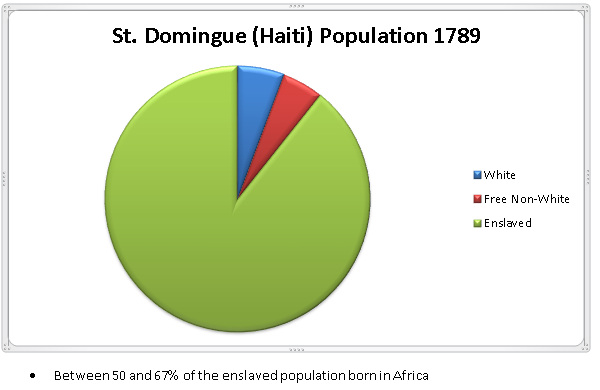
In Saint Domingue the enslaved population outnumbered the free non-whites and the white population by a significant amount. Then enslaved population in Saint Domingue was the majority and for that reason they were a big factor in the Haitian Revolution. In 1791 there was a slave revolt, in which they gained their freedom and were lead by . The French government had made sense of this revolt and had realized that it was only about time that they slaves would revolt. The slave revolt was a success and they had gained their freedom, which caused further problems in Saint Domingue and ultimately lead to further complications and issues. As oppose to, the British colonies majority of the population were white and free. So they never had to discuss slavery at all because the slavery population was much lower.

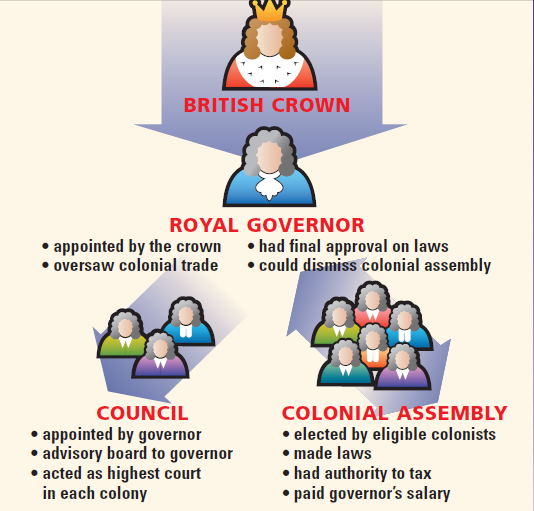
The French colony had even more problems as they were on the verge of independence. Saint Domingue was always controlled and ruled by people sent from the French crown. The colonist and the newly freed blacks didn't have any experience in governing and ruling. They did not have a system of government in place when they were becoming independent or even when they became independent. So this situation and lack of experience lead to even further complication. Whereas, the British colonies had colonial assembly and were more experienced in governing, not to mention they were in more direct contact with the British king. The colonist played a governing role and had a system of government in place before they even became independent.

Overall, the British colonies in the north were better prepared and experienced for their independence. They were more united and had one common goal, while Haiti had many different cultures and people with different ideas. The British colonies were more independent even before they became independent. Compared to Haiti which was more dependent on the French crown for governing. There are many more reason why the British colonies were better prepared than the Latin American colonies, but these are two important ones. These situation and decisions affected the future of both nation for hundreds of years.    

Wednesday, October 23, 2013

The Republic of Haiti

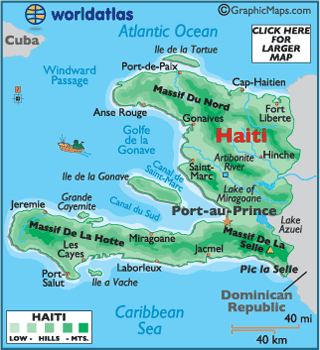
The Haitian people were once citizens of the French colony, Saint Domingue. After many conflicts and revolts the Haitian people had enough of the French aristocracy and declared their independence. But the colony that was once France's most vital economic settlement was not going to become free that easily. Napoleon Bonaparte and his American allies came down upon the Haitian people, after one failed attempt to recapture Saint Domingue, he made them a proposition that will leave a mark on Haiti for years to come.

Napoleon forced the new Haitian people to pay him 100 million francs for official recognition. But to make matters worse for this young nation is that they had to borrow the money from a single French bank. This enabled the bank to charge extravagant interest rates; making Haiti unable to pay off it's debt for almost a century. This debt put a severe damper on Haiti's economy, and to add on to their failing economy they were suffering from post-independence isolation from rest of the world. Different countries may have isolated themselves from Haiti for various reasons, but there was one major common reason. The Haitian leader Toussaint L'Ouverture was a well respected man black man among the Haitian people. He helped in the success of the slave revolt that took place in Haiti, which made many other nations scared. L'Ouverture abolished slavery within Haiti which made their economy suffer even more on top of everything else. 

Outside of the French and Haitian relationship laid America, the first nation to be born in the new world. Although America had gone through similar circumstances with the British during their revolution, they did not support Haiti. In fact, America did not recognize Haiti as an independent nation until six decades later when it was in midst of the American Civil War. During the time when Haiti became independent Thomas Jefferson was Vice President of the United States and later became President. He tried to block off trade with Haiti, joined forces with France to conquer Haiti, and kept the American people as far as possible from Haiti. Thomas Jefferson, one of the Founding Fathers of American, and a major player in the American Revolution was trying to stop a revolution. He was scared that the ideas and ideals in Haiti will spread to the American South. Thomas Jefferson didn't want black slaves in America to revolt as they did in Haiti. He didn't want them to be inspired by Toussaint L'Ouverture as a black leader of his own nation.

Haiti suffered from all aspects and all corners of the globe when they became independent. They themselves hurt their economy in a extravagant manner by abolishing slavery. They suffered even more as they owed France 100 million france; and could only take a loan from one French bank. The Haitians were isolated from the world without any allies to help them in their state of despair. America tried everything possible to hold Haiti down because they were scared of what it would do in their own nation. From the very start of Haiti's independence they suffered a great deal which had an impact that lasted years after. As they were a suffering nation to begin with, in 2010 they felt the impact of a devastating earthquake that destroyed a large portion of their country. A tragedy that would cost them 14 billion dollars to rebuild, after rebuilding for the last 200 years Haiti will once again have to suffer.  
      

Monday, October 21, 2013

Napoleon Bonaparte's Everlasting Impact

http://knarf.english.upenn.edu/Gifs/napoleon.gif
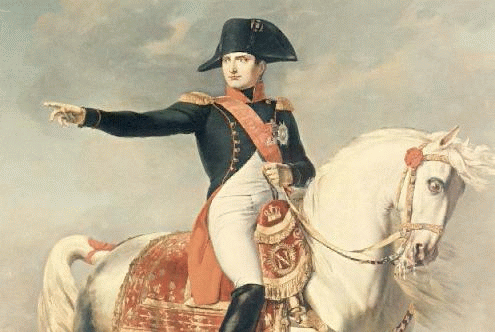
Napoleon was viewed in many different ways; some saw him as a hero and other saw him as a tyrant. Nevertheless Napoleon Bonaparte was a conqueror of many lands. Under his rule he influenced the lives of many; some for the better and some for the worse. Napoleon impacted the social, economic, and political systems of many European countries. He abolished serfdom in the countries he took over. He created new trade agreements with different countries, improving the economy for every country under his command. Lastly, even though he was a dictator he gave the people more power and say in their local government. He made the day to day lives of his people better in a way they never imagined. The new lives Napoleon created for his people will have an everlasting effect on their countries.

Not everyone was a fan of Napoleon, such as Madame de Stael, the daughter of one of King Louis XVI's advisers. She viewed Napoleon as a tyrant who is war crazed and has no appreciation for elegance and intellectual riches. de Stael grew up as nobility which was not treated as well under Napoleon's rule as they were under King Louis's. For that reason is against Napoleon and everything he stands for. On the other hand the soldiers that serve him, as in the case of Marshal Michel Ney were great supporters of Napoleon. Ney viewed Napoleon as a brave and courageous leader who is the rightful emperor of France. He calls Napoleon the "immortal legion" and "august emperor". This shows that the people who knew him respected him and the nobility hated him. Napoleon did many things to help the lower class, which in turn gave him the largest army of his time. All his soldiers were volunteer, he never had a draft for his wars. His people rallied behind him in support for his conquests.

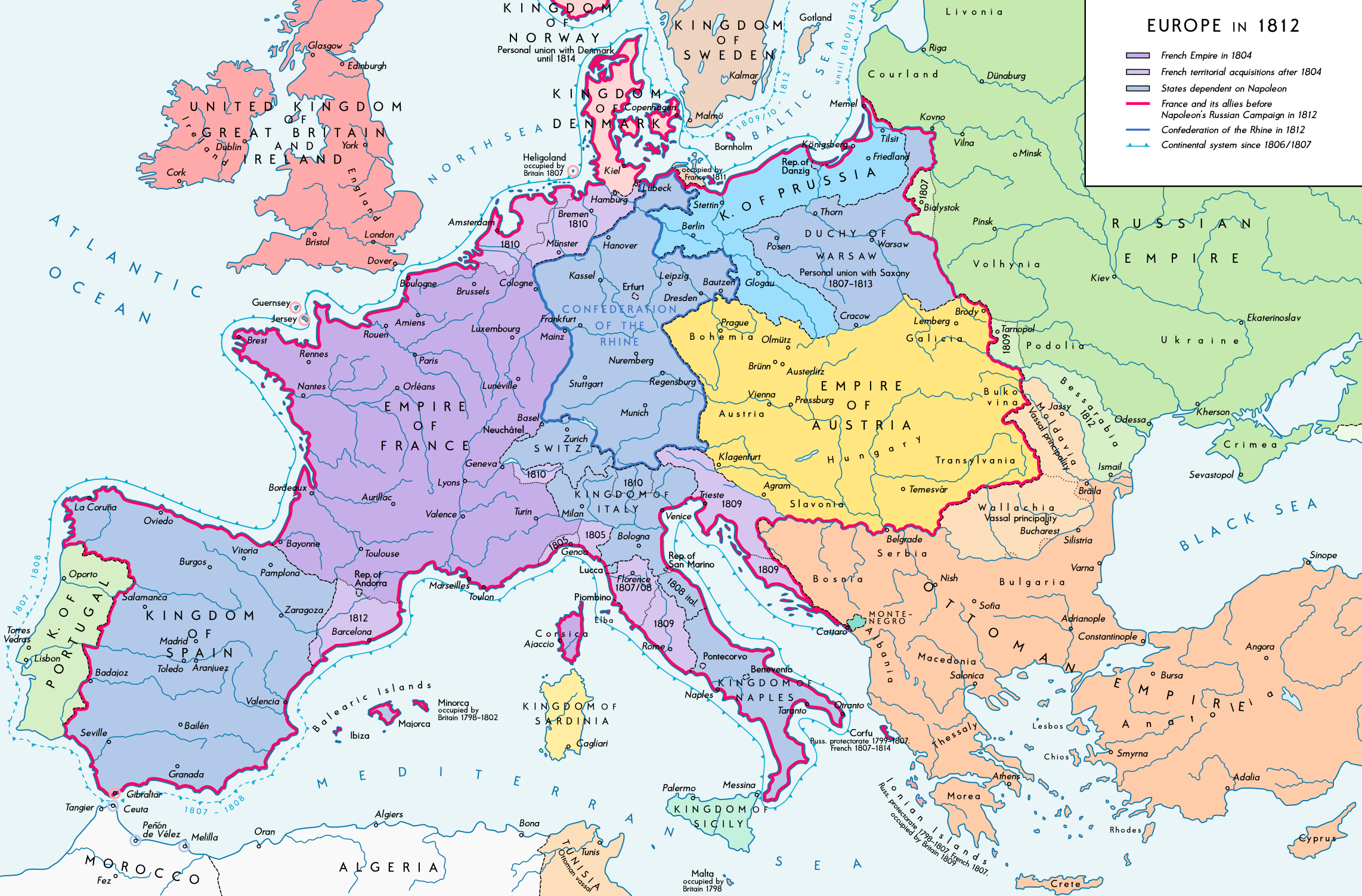
http://upload.wikimedia.org/wikipedia/commons/f/f5/
Europe_1812_map_en.png
Under Napoleon's great reign the people of Italy, Austria, Belgium, Venice, Egypt, Holland, Prussia, Russia, Spain, and for a little while Portugal were able to experience power and prosperity they never felt before. Once Napoleon gave these people better lives they didn't want to go back to the way things were before. As a result when Napoleon fell and the old government and nobles came back to reclaim what they had lost, the people naturally resisted. They didn't want their old government and system back, which led to the many revolution that occurred in Europe. Because they wanted what Napoleon gave them they resisted going backwards. Napoleon impacted every aspect of their lives he made them richer, he gave them more of a voice, and most of all he minimized class distinction. With serfdom abolished and nobles with less power, Napoleon created a society where the majority of people prospered and benefited. This effect lead them to having revolution in the near future after the fall of Napoleon.


Wednesday, October 9, 2013

Mary Paul Letters

http://www.uml.edu/tsongas/bringing-history-home/page_01/images/L-67-f.jpg
At first Mary Paul is excited and eager to go to the mills. She sends a letter to her father asking permission to go to the mills, she is supported by her aunt and her friend who is also going to the mills. Mary wants to make money, buy her own clothes and live on her own. She feels the same way most teenagers even now feel, she want to get out of the house and live around girls her age. Her father gives her permission to go, and after a few months her next letter is full of frustration and sadness. It seems like she misses everyone from back home, she tells her father to write back; right when he reads the letter. She also tells him to come visit and have other people write to her and visit. She is quite frustrated with the fact that she has barely saved any money. She complains about how the ride to the mills was more expensive than she thought it would be. Mary is also frustrated will all her other expenses upon her arrival. Her third letter has a positive tone but negative content. It begins by saying all the bad thing that have happened to the people around her; trying to demonstrate the dangers in Lowell. It mentions people breaking their ribs and dieing. Then it describes her daily life and schedule which she expresses with positivity. Mary talks about how she is pretty good at work and how much money she has made and the things she has bought. She states that the mills are the best place for her, and she recommended it to other girls. As the letters go on and on, her attitude and tone towards the mills becomes more negative. In the last letter she expresses a miserable tone, she was sick and can barely work; and believes that she won't get paid very well for the last few days even though he has worked very hard.
http://www.uml.edu/tsongas/bringing-history-home/endings/images/L-123-f.jpg

I think that the Lowell Experiment was a success and a failure; it was meant for young girls to work for a few years as a temporary job. Then quit to go back home to get married and start a family. The way Mary
y feels in the beginning is the way most girls probably felt. The mills was only a good place for a short amount of time, and the longer you stay the worse it gets. So i believe that it is a success as long as the girls follow the "experiment". In Mary's case I believe that she stayed there for too many years and she become more and more sick of it and it got to the point where she became miserable. The Lowell Experiment was partly a success and partly a failure, it gave young girls an opportunity to make money and live on their own in fairly good condition. But it had a limit to it and didn't give any room for improvement or advancement. Working at the mills after a certain amount of time becomes unproductive, but as we saw in Mary's case it was productive in the beginning. She made her own money, made many new friends, and was put in a good and kind environment. Until she got sick and had to go home for 6 months before returning back to the mill. This is where I believe it the experiment becomes a failure, she came back and got a worse position and made less money. Her position was taken up by some other girl and Mary could not do what she did before. This is the turning point in the "Lowell Experiment".     

Friday, October 4, 2013

Where do the opportunities lay?

Where do you want to be during the industrial revolution if you were a mere peasant? Where do you want to be if you were a wealthy industrialist? After all the documents and videos we have observed in class, it has become clear that if you are an industrialist, you would want to be in Great Britain. Whereas, if you are a worker you would want to be in the United States.

http://alafoto.com/shepps/images/fig013.png
Great Britain has more workers, and less opportunities; meaning that everyone would want to work for you and whoever had a problem can be easily replaced. Less opportunities for people force them to work for you; and take whatever pay and conditions you offer them. If you were a factory owner then you could make bigger profits in Great Britain because you can pay your workers a low wage, and they would have no choice but to take it. Whereas in the United States there is plenty of land and less workers; so you would have to treat the workers better and pay them better because they could easily leave, and do something else. In Great Britain, as an industrialist you have many raw materials at your disposal because of all the British colonies. This allowed for you to produce and invest in different goods. Also it allowed for more inventions to be built in Britain. Also in Britain they had invented steam powered ships that would make transportation of goods internationally faster and easier. On top of that they had made roads that last longer and railroads so transportation of goods nationally also become faster and easier. Industrialists in Britain were more likely to succeed than in the United States; the industrialist had more advantages in Britain that made it a better place to make money.

http://www.uml.edu/tsongas/bringing-history-home/page_02/images/L-18-f.jpg
In the United States there was endless opportunity; the land was open as far as the eye could see. This enabled workers in the US to have a more positive experience. Factory owners had to pay them well, and treat them well, because if the workers had other opportunities. A factory job wasn't a workers only option; which made the factories pay them better than factories in GB. When we compare the schedules between mill workers in GB and the US we can clearly see that the workers in the US had more breaks, more sleep, and more pay. The US was not fantastic but compared to GB it was considerably better. If you compare Emily Nutter's schedule at the Mill in Lowell and William Coopers schedule at the Mill in GB, it is clear that Emily's life is easier. She has time to eat breakfast, dinner, and supper, and have free time to do whatever she wants. On the other hand William Cooper only has a 40 minute break for lunch for the whole day. He has to eat breakfast on the run and eat dinner on the run. He had to work till 9 p.m for a total of 16 hours; whereas Emily worked till 7 p.m, for a total of 12 hours. In the US only one member of the family had to go, unlike GB where the whole family had to move to the city to work. The girls lived in boarding houses which taught them independence but also they were with other girls their age. These boarding houses were compared to academies where they kept the girls disciplined and moral. Overall the workers had more advantages in the US than in GB, they lived better lives and had more opportunities.