Wednesday, October 23, 2013
The Republic of Haiti
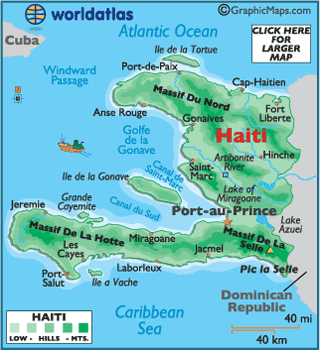
The Haitian people were once citizens of the French colony, Saint Domingue. After many conflicts and revolts the Haitian people had enough of the French aristocracy and declared their independence. But the colony that was once France's most vital economic settlement was not going to become free that easily. Napoleon Bonaparte and his American allies came down upon the Haitian people, after one failed attempt to recapture Saint Domingue, he made them a proposition that will leave a mark on Haiti for years to come.
Napoleon forced the new Haitian people to pay him 100 million francs for official recognition. But to make matters worse for this young nation is that they had to borrow the money from a single French bank. This enabled the bank to charge extravagant interest rates; making Haiti unable to pay off it's debt for almost a century. This debt put a severe damper on Haiti's economy, and to add on to their failing economy they were suffering from post-independence isolation from rest of the world. Different countries may have isolated themselves from Haiti for various reasons, but there was one major common reason. The Haitian leader Toussaint
L'Ouverture was a well respected man black man among the Haitian people. He helped in the success of the slave revolt that took place in Haiti, which made many other nations scared. L'Ouverture abolished slavery within Haiti which made their economy suffer even more on top of everything else.
Outside of the French and Haitian relationship laid America, the first nation to be born in the new world. Although America had gone through similar circumstances with the British during their revolution, they did not support Haiti. In fact, America did not recognize Haiti as an independent nation until six decades later when it was in midst of the American Civil War. During the time when Haiti became independent Thomas Jefferson was Vice President of the United States and later became President. He tried to block off trade with Haiti, joined forces with France to conquer Haiti, and kept the American people as far as possible from Haiti. Thomas Jefferson, one of the Founding Fathers of American, and a major player in the American Revolution was trying to stop a revolution. He was scared that the ideas and ideals in Haiti will spread to the American South. Thomas Jefferson didn't want black slaves in America to revolt as they did in Haiti. He didn't want them to be inspired by Toussaint L'Ouverture as a black leader of his own nation.
Haiti suffered from all aspects and all corners of the globe when they became independent. They themselves hurt their economy in a extravagant manner by abolishing slavery. They suffered even more as they owed France 100 million france; and could only take a loan from one French bank. The Haitians were isolated from the world without any allies to help them in their state of despair. America tried everything possible to hold Haiti down because they were scared of what it would do in their own nation. From the very start of Haiti's independence they suffered a great deal which had an impact that lasted years after. As they were a suffering nation to begin with, in 2010 they felt the impact of a devastating earthquake that destroyed a large portion of their country. A tragedy that would cost them 14 billion dollars to rebuild, after rebuilding for the last 200 years Haiti will once again have to suffer.
Monday, October 21, 2013
Napoleon Bonaparte's Everlasting Impact
| http://knarf.english.upenn.edu/Gifs/napoleon.gif |
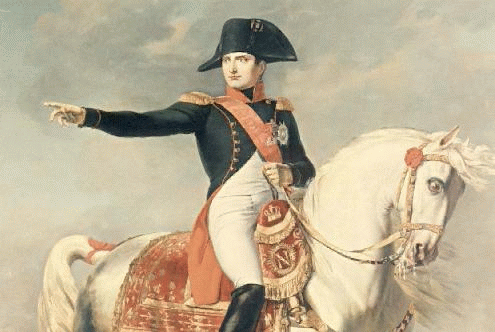
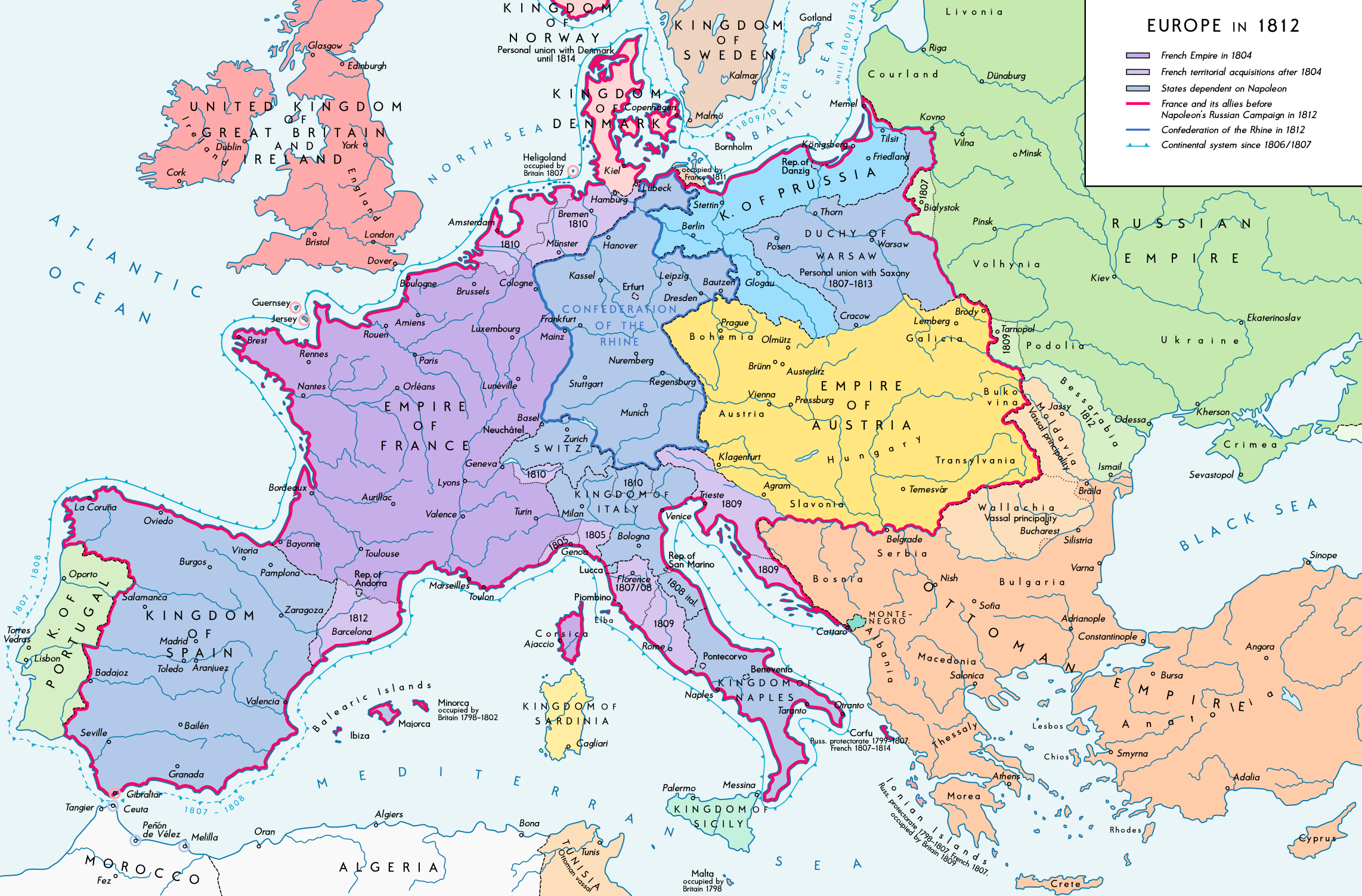
Not everyone was a fan of Napoleon, such as Madame de Stael, the daughter of one of King Louis XVI's advisers. She viewed Napoleon as a tyrant who is war crazed and has no appreciation for elegance and intellectual riches. de Stael grew up as nobility which was not treated as well under Napoleon's rule as they were under King Louis's. For that reason is against Napoleon and everything he stands for. On the other hand the soldiers that serve him, as in the case of Marshal Michel Ney were great supporters of Napoleon. Ney viewed Napoleon as a brave and courageous leader who is the rightful emperor of France. He calls Napoleon the "immortal legion" and "august emperor". This shows that the people who knew him respected him and the nobility hated him. Napoleon did many things to help the lower class, which in turn gave him the largest army of his time. All his soldiers were volunteer, he never had a draft for his wars. His people rallied behind him in support for his conquests.
| http://upload.wikimedia.org/wikipedia/commons/f/f5/ Europe_1812_map_en.png |
Wednesday, October 9, 2013
Mary Paul Letters
| http://www.uml.edu/tsongas/bringing-history-home/page_01/images/L-67-f.jpg |
I think that the Lowell Experiment was a success and a failure; it was meant for young girls to work for a few years as a temporary job. Then quit to go back home to get married and start a family. The way Mary
y feels in the beginning is the way most girls probably felt. The mills was only a good place for a short amount of time, and the longer you stay the worse it gets. So i believe that it is a success as long as the girls follow the "experiment". In Mary's case I believe that she stayed there for too many years and she become more and more sick of it and it got to the point where she became miserable. The Lowell Experiment was partly a success and partly a failure, it gave young girls an opportunity to make money and live on their own in fairly good condition. But it had a limit to it and didn't give any room for improvement or advancement. Working at the mills after a certain amount of time becomes unproductive, but as we saw in Mary's case it was productive in the beginning. She made her own money, made many new friends, and was put in a good and kind environment. Until she got sick and had to go home for 6 months before returning back to the mill. This is where I believe it the experiment becomes a failure, she came back and got a worse position and made less money. Her position was taken up by some other girl and Mary could not do what she did before. This is the turning point in the "Lowell Experiment".
Friday, October 4, 2013
Where do the opportunities lay?
Where do you want to be during the industrial revolution if you were a mere peasant? Where do you want to be if you were a wealthy industrialist? After all the documents and videos we have observed in class, it has become clear that if you are an industrialist, you would want to be in Great Britain. Whereas, if you are a worker you would want to be in the United States.
| http://alafoto.com/shepps/images/fig013.png |
Great Britain has more workers, and less opportunities; meaning that everyone would want to work for you and whoever had a problem can be easily replaced. Less opportunities for people force them to work for you; and take whatever pay and conditions you offer them. If you were a factory owner then you could make bigger profits in Great Britain because you can pay your workers a low wage, and they would have no choice but to take it. Whereas in the United States there is plenty of land and less workers; so you would have to treat the workers better and pay them better because they could easily leave, and do something else. In Great Britain, as an industrialist you have many raw materials at your disposal because of all the British colonies. This allowed for you to produce and invest in different goods. Also it allowed for more inventions to be built in Britain. Also in Britain they had invented steam powered ships that would make transportation of goods internationally faster and easier. On top of that they had made roads that last longer and railroads so transportation of goods nationally also become faster and easier. Industrialists in Britain were more likely to succeed than in the United States; the industrialist had more advantages in Britain that made it a better place to make money.
| http://www.uml.edu/tsongas/bringing-history-home/page_02/images/L-18-f.jpg |
In the United States there was endless opportunity; the land was open as far as the eye could see. This enabled workers in the US to have a more positive experience. Factory owners had to pay them well, and treat them well, because if the workers had other opportunities. A factory job wasn't a workers only option; which made the factories pay them better than factories in GB. When we compare the schedules between mill workers in GB and the US we can clearly see that the workers in the US had more breaks, more sleep, and more pay. The US was not fantastic but compared to GB it was considerably better. If you compare Emily Nutter's schedule at the Mill in Lowell and William Coopers schedule at the Mill in GB, it is clear that Emily's life is easier. She has time to eat breakfast, dinner, and supper, and have free time to do whatever she wants. On the other hand William Cooper only has a 40 minute break for lunch for the whole day. He has to eat breakfast on the run and eat dinner on the run. He had to work till 9 p.m for a total of 16 hours; whereas Emily worked till 7 p.m, for a total of 12 hours. In the US only one member of the family had to go, unlike GB where the whole family had to move to the city to work. The girls lived in boarding houses which taught them independence but also they were with other girls their age. These boarding houses were compared to academies where they kept the girls disciplined and moral. Overall the workers had more advantages in the US than in GB, they lived better lives and had more opportunities.
Monday, September 30, 2013
Smith, Adam. The Wealth of Nations (Excerpts). Modified from the Modern History Internet Sourcebook. 1776. Fordham University. http://www.fordham.edu/halsall/mod/adamsmith-summary.asp.
Adam Smith was a brilliant man that came up with ideal that we follow to this day. Smith's journey began when he attended the University of Glasgow. At Glasgow he distinguished himself as a inquisitive scholar, in turn he won a scholarship to Oxford University one of the worlds most prestigious school. He studied at Oxford for 6 years, from 1740 to 1746. Once he left Oxford he began giving public lectures that made him somewhat famous, which led to him being appointed as professor of moral philosophy at the University of Glasgow. It is clear that Adam Smith was not only a well educated man, but an exceptional scholar and philosopher from an early age. He was quickly recognized for his brilliance through his lectures and his first book, The Theory of Moral Sentiment. Adam Smith is known as the father of Capitalism, after he published The Wealth of Nations. He believed in many things that were already in place, and introduced many new original ideas that were never though of before. Smith wrote the Wealth of Nations, in order to give full explanations of his ideas. His book discusses many of the essential parts of capitalism today.
Smith begins with talking about his idea of division of labor. He says that it is more efficient if the production of one item is broken down into different branches, where one person specializes in one branch of production. He uses an example with the production of pins, stating that alone you might be able to make one pin a day, but with 8 other people each who specialize in one part of production, you can make hundreds of pins in one day. Smith demonstrates and explains each part of his division of labor idea in this excerpt. In the second part, he discusses the principle that gives occasion to the division of labor. He states that people do things in their own self interest, and that working together (division of labor) is in peoples best interests. He demonstrates this through saying " it is not through the benevolence of the butcher, the brewer, or the baker that we expect our dinner, but from their regard to their own interest." Meaning that each person who takes part in the production of your "dinner" (product), is acting in their own self interest which in turn is helping everyone else. Adam Smith uses examples that show progression and positive impacts on all parties involved in the example.
*I would have indented every line except the first line on the annotation and citation.
Adam Smith was a brilliant man that came up with ideal that we follow to this day. Smith's journey began when he attended the University of Glasgow. At Glasgow he distinguished himself as a inquisitive scholar, in turn he won a scholarship to Oxford University one of the worlds most prestigious school. He studied at Oxford for 6 years, from 1740 to 1746. Once he left Oxford he began giving public lectures that made him somewhat famous, which led to him being appointed as professor of moral philosophy at the University of Glasgow. It is clear that Adam Smith was not only a well educated man, but an exceptional scholar and philosopher from an early age. He was quickly recognized for his brilliance through his lectures and his first book, The Theory of Moral Sentiment. Adam Smith is known as the father of Capitalism, after he published The Wealth of Nations. He believed in many things that were already in place, and introduced many new original ideas that were never though of before. Smith wrote the Wealth of Nations, in order to give full explanations of his ideas. His book discusses many of the essential parts of capitalism today.
Smith begins with talking about his idea of division of labor. He says that it is more efficient if the production of one item is broken down into different branches, where one person specializes in one branch of production. He uses an example with the production of pins, stating that alone you might be able to make one pin a day, but with 8 other people each who specialize in one part of production, you can make hundreds of pins in one day. Smith demonstrates and explains each part of his division of labor idea in this excerpt. In the second part, he discusses the principle that gives occasion to the division of labor. He states that people do things in their own self interest, and that working together (division of labor) is in peoples best interests. He demonstrates this through saying " it is not through the benevolence of the butcher, the brewer, or the baker that we expect our dinner, but from their regard to their own interest." Meaning that each person who takes part in the production of your "dinner" (product), is acting in their own self interest which in turn is helping everyone else. Adam Smith uses examples that show progression and positive impacts on all parties involved in the example.
*I would have indented every line except the first line on the annotation and citation.
Tuesday, September 24, 2013
The Luddites were a group of people located in and around London, England who believed that technology was being misused. This group protested in many memorable way, once they dressed up as women, in order to gain attention. Luddites were particularly violent, although they never really killed people, but they would break into factories and destroy machineries. The group wanted higher wages, better working conditions, and most of all equality. People part of the Luddites were living in filthy conditions, full of pollution and poverty. Throughout England the Luddites were a very controversial topic. The upperclass and artisans were in favor of the Luddites, while factory managers and business owners opposed them. Upper Class people came from money and had government jobs, so they didn't lose anything or gain anything. But the artisans made money by working at home and providing a service, which is now done in factories. These people lost their jobs and livelihood. The factory managers made more money than ever before, and business owners bought factory made goods at a lower price than ever before. This letter to the Luddites from a weaver will give a clearer view of one of these perspectives (Note this is a mock primary source).
To, The Luddite Commision
I am a long time, skilled weaver outside of London. These factories within the city has affected my business considerably. I would join them but their wages are not high enough for me to even provide for myself, much less my family. I plead to you in this letter, to force these factories into paying a higher, decent wage. A year or two ago I was prosperous and could provide for my family graciously. Now I am struggling just to put food on the table every night. I've been a weaver for many years and I am skilled with my hands, but that not longer matters to the world. You are my last and only hope to end the suffering of my family and I. My sons want to go off and work in the factories to help, but the way they treat the children there is inhumane. The conditions in the factory is terrible, if starvation doesn't kill my children or I, those factories will. I am willing to help in anyway possible if that is what it takes. I have read in the paper of your most recent activities and would like to be a part of this movement. My family and I celebrate your victories in London, and the Luddites are what give us hope for a better future.
From, Weaver John
To, The Luddite Commision
I am a long time, skilled weaver outside of London. These factories within the city has affected my business considerably. I would join them but their wages are not high enough for me to even provide for myself, much less my family. I plead to you in this letter, to force these factories into paying a higher, decent wage. A year or two ago I was prosperous and could provide for my family graciously. Now I am struggling just to put food on the table every night. I've been a weaver for many years and I am skilled with my hands, but that not longer matters to the world. You are my last and only hope to end the suffering of my family and I. My sons want to go off and work in the factories to help, but the way they treat the children there is inhumane. The conditions in the factory is terrible, if starvation doesn't kill my children or I, those factories will. I am willing to help in anyway possible if that is what it takes. I have read in the paper of your most recent activities and would like to be a part of this movement. My family and I celebrate your victories in London, and the Luddites are what give us hope for a better future.
From, Weaver John
Friday, September 20, 2013
Industrial Revolution Museum
![]() |
| Living Conditions in England During the Industrial Revolution |
When we were given our 5 sources we carefully examined each one together. Then we handed one source out to each person in our group to become experts on each one. Once we individually became experts on our sources we shared with our group, to get a fuller understanding of all the sources. This process is important because we need to figure out what the major idea of our sources are. In order to do that we must know how all the information we are given work together. In this case we learned a lot about the living conditions during this time period. We noticed that all our sources had to do with the living conditions in England. We noticed that the sources were showing that the conditions were bad and declining. Once we figured this information out, we discussed how to organize our exhibit. We decided to put our title in big letters and in the middle, because all the sources are based around our title. Then we used a back ground to color code our sources, to categorize them. Our picture sources have a dark blue background, our chart and map have a light blue background, and the two writing articles have a black background. Each member of our group wrote summaries about our sources so we can get an even better understanding, and our viewers can easily extract important information from our exhibit. Both our pictures are of Manchester, one shows many people on the street and the other shows smokestacks and lots of pollution. The map of England shows when and where inventions were made in england, and the population of each city. The chart shows the living cost and earning during the time period. We see that the living cost goes up faster than the earnings. One of the writing passages shows us two different perspectives of the Industrial Revolution. And the other writing passage is a letter that describes the living conditions in a part of England. It describes the disgusting state the water in the river was, and the smell of the air. When people look at our exhibit they will learn about the life in England during the Industrial Revolution. They should easily realize how bad the condition was and how much pollution was in the air and water. People should learn what inventions where made during this time and how that effected the economy and peoples lives in England. That is why we titles our exhibit The Living Conditions in England During the Industrial Revolution.
| Work Destroys Children's Lives |
This whole exhibit was based around child labor during the Industrial Revolution. It shows us the dangerous jobs they were required to do, and the terrible conditions they were required to work and live in. Children in this time period were doing work that could kill them in the long run.
| Cotton Creating Connections |
One of the inventions during the Industrial Revolution effected the Cotton industry immensely. Cotton demands were booming and this exhibit shows the effect it had on slavery. From this graph and the rest of the exhibit it becomes clear that the industrial revolution had a increased the rate of slavery tremendously.
| Change is Looming |
| All aboard the steam engine rail road and canals |
Subscribe to:
Posts (Atom)